
Physicians: Click on images to print for patients

ophthalmology and nutrition REFERENCES
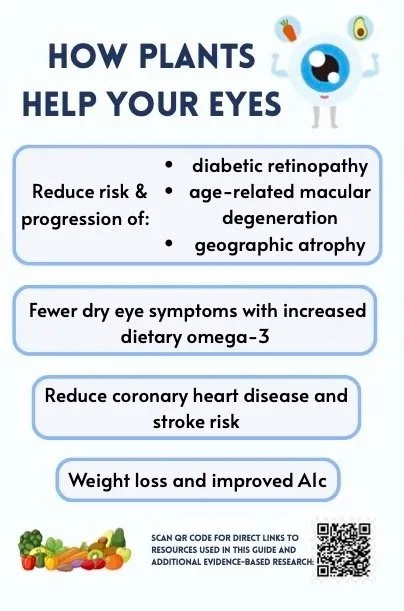
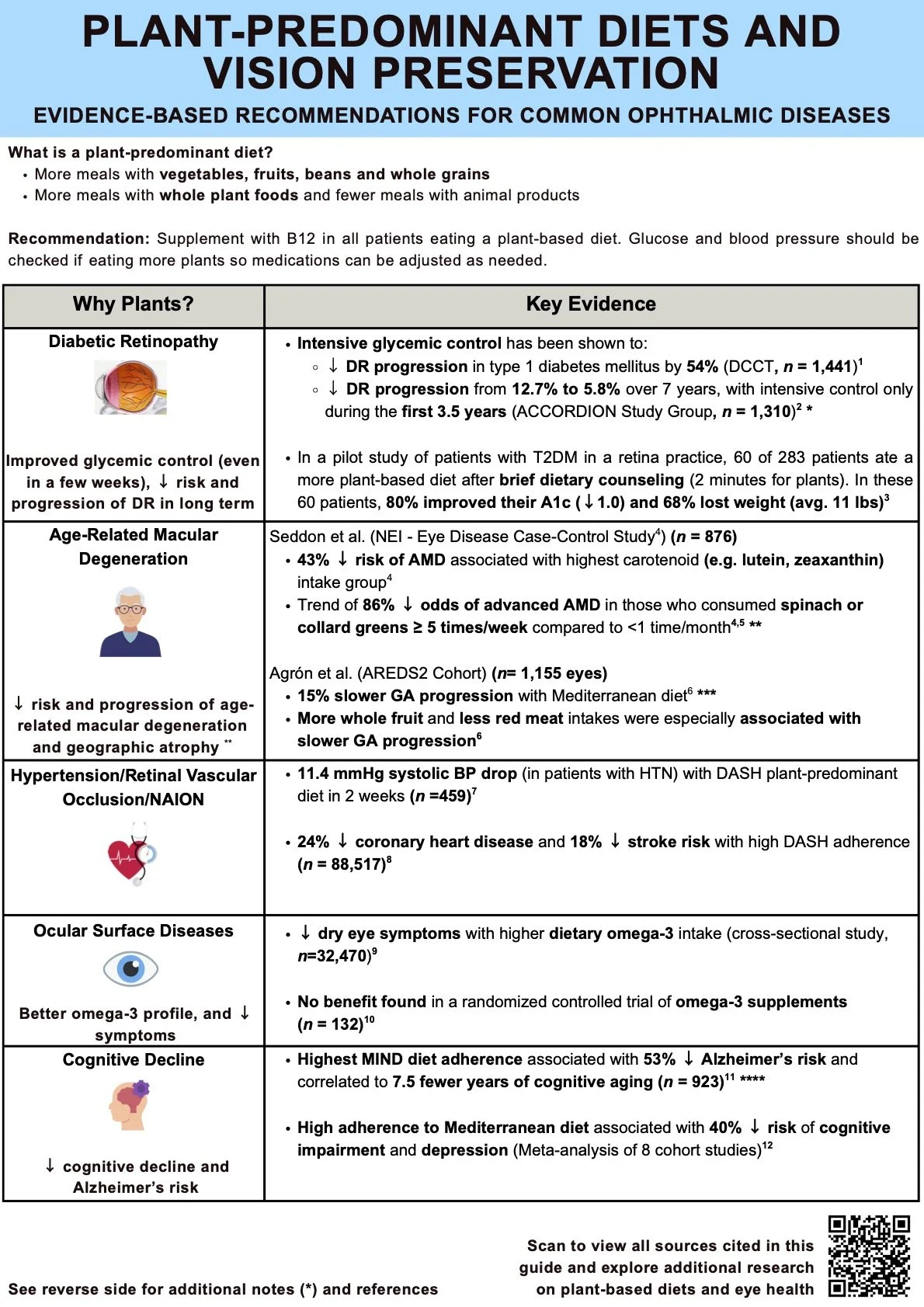
Intensive glycemic control has been shown to:↓ DR progression in type 1 diabetes mellitus by 54% (DCCT, n = 1,441) 1, ↓ DR progression from 12.7% to 5.8% over 7 years, with intensive control only during the first 3.5 years (ACCORDION Study Group, n = 1,310) 2*
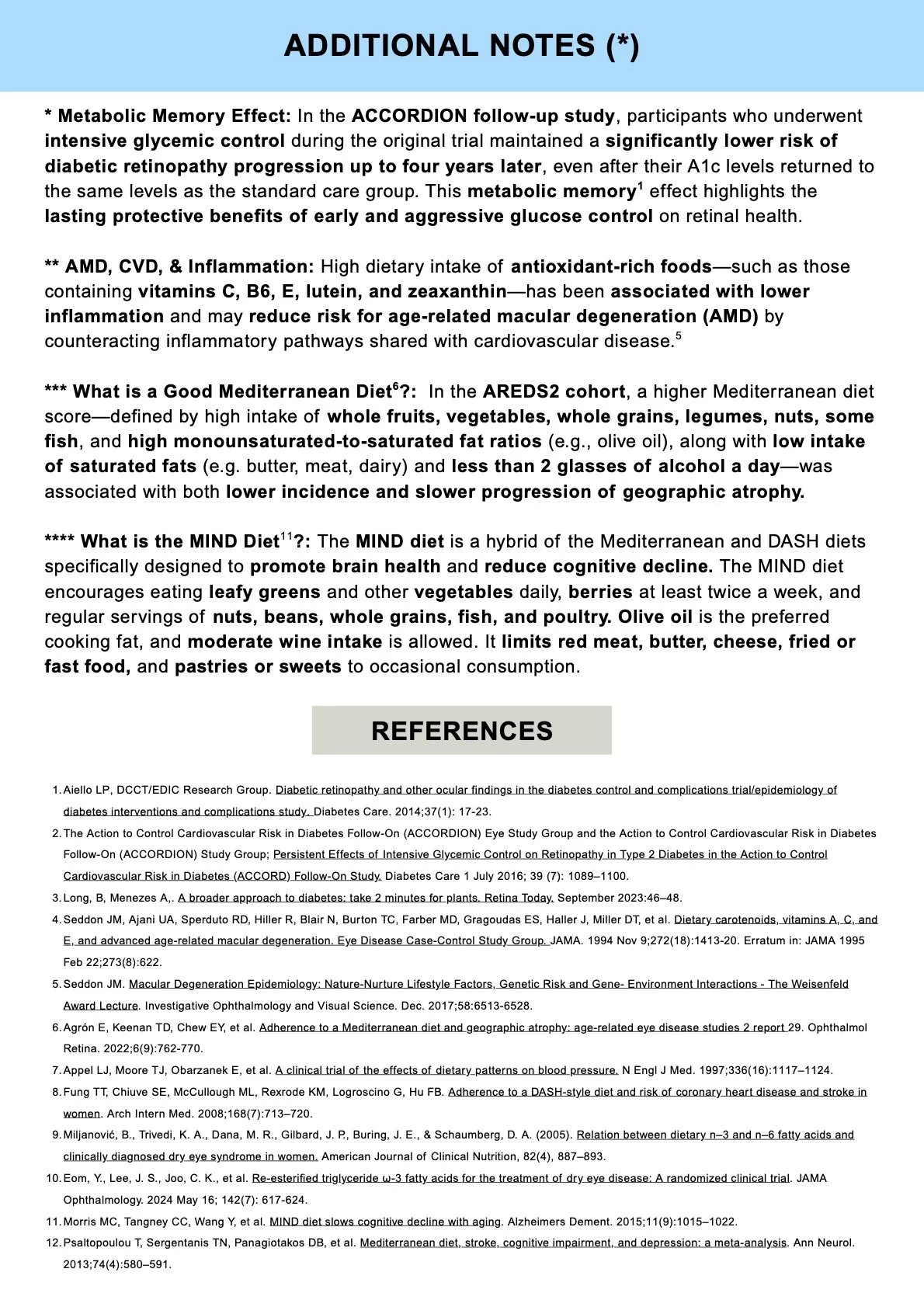
1. Aiello LP, DCCT/EDIC Research Group. Diabetic retinopathy and other ocular findings in the diabetes control and complications trial/epidemiology of diabetes interventions and complications study. Diabetes Care. 2014;37(1): 17-23.
2.The Action to Control Cardiovascular Risk in Diabetes Follow-On (ACCORDION) Eye Study Group and the Action to Control Cardiovascular Risk in Diabetes Follow-On (ACCORDION) Study Group; Persistent Effects of Intensive Glycemic Control on Retinopathy in Type 2 Diabetes in the Action to Control Cardiovascular Risk in Diabetes (ACCORD) Follow-On Study. Diabetes Care 1 July 2016; 39 (7): 1089–1100..
In a pilot study of patients with T2DM in a retina practice, 60 of 283 patients ate a more plant-based diet after brief dietary counseling (2 minutes for plants). In these 60 patients, 80% improved their A1c (↓1.0) and 68% lost weight (avg. 11 lbs)3
3.Long, B, Menezes A,. A broader approach to diabetes: take 2 minutes for plants. Retina Today. September 2023:46–48.
Seddon et al. (NEI - Eye Disease Case-Control Study ) (n = 876). 43% ↓ risk of AMD associated with highest carotenoid (e.g. lutein, zeaxanthin) intake group4. Trend of 86% ↓ odds of advanced AMD in those who consumed spinach or collard greens ≥ 5 times/week compared to <1 time/month 4,5**
4.Seddon JM, Ajani UA, Sperduto RD, Hiller R, Blair N, Burton TC, Farber MD, Gragoudas ES, Haller J, Miller DT, et al. Dietary carotenoids, vitamins A, C, and E, and advanced age-related macular degeneration. Eye Disease Case-Control Study Group. JAMA. 1994 Nov 9;272(18):1413-20. Erratum in: JAMA 1995 Feb 22;273(8):622.
5.Seddon JM. Macular Degeneration Epidemiology: Nature-Nurture Lifestyle Factors, Genetic Risk and Gene- Environment Interactions - The Weisenfeld Award Lecture. Investigative Ophthalmology and Visual Science. Dec. 2017;58:6513-6528.
Agrón et al. (AREDS2 Cohort) (n= 1,155 eyes): 15% slower GA progression with Mediterranean diet 6***. More whole fruit and less red meat intakes were especially associated with slower GA progression6
6.Agrón E, Keenan TD, Chew EY, et al. Adherence to a Mediterranean diet and geographic atrophy: age-related eye disease studies 2 report 29. Ophthalmol Retina. 2022;6(9):762-770..
11.4 mmHg systolic BP drop (in patients with HTN) with DASH plant-predominant diet in 2 weeks (n =459)7. 24% ↓ coronary heart disease and 18% ↓ stroke risk with high DASH adherence (n = 88,517)8
7.Appel LJ, Moore TJ, Obarzanek E, et al. A clinical trial of the effects of dietary patterns on blood pressure. N Engl J Med. 1997;336(16):1117–1124.
8..Fung TT, Chiuve SE, McCullough ML, Rexrode KM, Logroscino G, Hu FB. Adherence to a DASH-style diet and risk of coronary heart disease and stroke in women. Arch Intern Med. 2008;168(7):713–720.
↓ dry eye symptoms with higher dietary omega-3 intake (cross-sectional study, (n=32,470)9. No benefit found in a randomized controlled trial of omega-3 supplements (n = 132)10
9.Miljanović, B., Trivedi, K. A., Dana, M. R., Gilbard, J. P., Buring, J. E., & Schaumberg, D. A. (2005). Relation between dietary n–3 and n–6 fatty acids and clinically diagnosed dry eye syndrome in women. American Journal of Clinical Nutrition, 82(4), 887–893.
10.Eom, Y., Lee, J. S., Joo, C. K., et al. Re-esterified triglyceride ω-3 fatty acids for the treatment of dry eye disease: A randomized clinical trial. JAMA Ophthalmology. 2024 May 16; 142(7): 617-624.
Highest MIND diet adherence associated with 53% ↓ Alzheimer’s risk and correlated to 7.5 fewer years of cognitive aging (n = 923) 11****. High adherence to Mediterranean diet associated with 40% ↓ risk of cognitive impairment and depression (Meta-analysis of 8 cohort studies)12
11.Morris MC, Tangney CC, Wang Y, et al. MIND diet associated with reduced incidence of Alzheimer’s disease. and MIND diet slows cognitive decline with aging. Alzheimers Dement. 2015;11(9):1015–1022.
12.Psaltopoulou T, Sergentanis TN, Panagiotakos DB, et al. Mediterranean diet, stroke, cognitive impairment, and depression: a meta-analysis. Ann Neurol. 2013;74(4):580–591.
